
If you’ve ever received a stack of resumes that missed the mark, waited too long for a candidate update, or watched a placement unravel in the first 90 days, the root cause is usually the same: a breakdown in hiring process communication somewhere between you and your recruiter.
This isn’t just about whether your staffing agency calls you back. Communication between a hiring manager and a staffing partner shapes everything downstream: the quality of candidates you see, how quickly roles get filled, whether placements actually stick, and whether the relationship is worth continuing past the first job order.
The problem is that most hiring managers inherit a broken communication dynamic without realizing it. A vague job brief here, a skipped feedback call there, and suddenly you’re three weeks in with no viable candidates and a position that’s costing your team more every day it stays open.
Below, we’ll break down where communication most commonly fails in the hiring process, what it costs you when it does, and the specific steps hiring managers can take to fix it before it derails your next search.

When Recruitment Communication Is Off, Your Whole Operation Feels It
Poor communication between a hiring manager and a staffing partner rarely stays contained to the hiring process. It ripples outward into project timelines, team morale, and your budget.
- Misaligned expectations are usually where it starts. Your recruiter needs a precise picture of your role: the job description, the dealbreakers, the team dynamic, the reason the last person didn’t work out. Otherwise, you’ll see candidates who look right on paper but aren’t in real life. Every round of mismatched resumes is a week lost.
- Project delays follow. When a role is time-sensitive and your staffing partner’s response time lags, the gap doesn’t just inconvenience HR. It lands on the team doing the work. Understaffed teams compensate by overextending, which leads to burnout, declining output, and sometimes turnover in the people you already have.
- Unresolved problems compound. Hiring challenges surface at every stage, from sourcing to the first 90 days post-hire. The ones that don’t get addressed early (because nobody flagged them, or the feedback loop between you and your recruiter is slow) become the ones that cost the most to fix later.
- Wasted resources are the bottom line. A replacement hire isn’t just a time cost. It’s a financial one. When a candidate is placed and doesn’t stick, the recruitment spend, onboarding investment, and productivity loss start over from zero.
Hiring Manager Takeaway: Before a search opens, give your recruiter more than a job description. Share a written brief that includes must-have skills, hard dealbreakers, and one or two examples of people who’ve succeeded (or failed) in the role. The more specific the input, the fewer mismatched candidates you’ll wade through.

Poor Candidate Quality Is Often a Communication Problem in Disguise
When a recruiting partner consistently delivers candidates who aren’t quite right, the instinct is to question their talent pool. More often, the issue is upstream — in what was (or wasn’t) communicated about the role.
Top talent doesn’t wait.
In a competitive market, strong candidates are fielding multiple opportunities simultaneously. If your recruiter isn’t moving with urgency — or isn’t getting timely feedback from your side — the best people accept offers elsewhere while your role sits open. Sometimes that means they go to a direct competitor.
Culture fit doesn’t survive a vague brief.
A candidate can check every box on a skills list and still be a morale problem within 60 days. If your staffing partner never asked about your team dynamic, management style, or what “good” actually looks like on the job, they’re essentially guessing. What looks great on paper can become a culture mismatch that’s expensive to unwind.
Candidate experience reflects on you, not just your agency.
Candidate communication during the hiring process shapes how they see your company. Not the staffing firm, your company. Slow updates, vague timelines, and unresponsiveness don’t just frustrate candidates; they drive word-of-mouth that affects your employer brand and future applicant quality.
If you want to go deeper on this, we’ve written about why candidate experience matters and how to optimize it.
Hiring Manager Takeaway: After every candidate submission, give your recruiter structured feedback. Not just “not quite right” but specifically what was missing and what came close. That calibration conversation is what separates a second-round submission that’s better from one that’s more of the same.

Weak Communication With Your Staffing Agency Erodes the Partnership Over Time
A single bad placement is recoverable. A pattern of poor communication between a hiring manager and a staffing provider is what turns a fixable problem into a failed partnership (and sometimes a lasting distrust of staffing agencies altogether).
- Unmet expectations compound into lost trust. When a staffing partner doesn’t fully understand your needs — or fails to communicate honestly about candidate availability and timelines — the disappointment accumulates. You start second-guessing every submission and hedging every commitment. That skepticism makes the relationship less effective, not more.
- Feedback loops that don’t exist can’t improve anything. Effective partnerships get better over time because both sides are learning. When communication is inconsistent or one-directional, there’s no mechanism for improvement. The quality of service stagnates, and you’re essentially starting from scratch with every search.
- One bad agency experience can poison the well for all of them. It’s worth naming directly: the reason many HR managers are reluctant to work with staffing agencies isn’t the industry — it’s a specific experience with poor communication that went unaddressed. Silence after a job order is placed. Candidates who clearly don’t match. Feeling like a transaction rather than a client. These experiences stick.
Hiring Manager Takeaway: Treat the first 30 days with a new staffing partner as a calibration period, not a test of whether they can read your mind. Schedule a check-in at the two-week mark specifically to course-correct — not to review candidates, but to review the communication itself. Are you getting the right updates? Is the feedback loop working? Fixing it early is exponentially cheaper than replacing the relationship later.
Download our one-page checklist:
4 Steps to Improved Recruitment Communication
(including the exact questions to ask your staffing partner before your first job order.)

How to Improve Hiring Process Communication With Your Staffing Partner
The good news: most recruiter communication breakdowns are fixable, and most of the fixes sit on both sides of the table. Here’s what you should own, and what you should expect your staffing partner to deliver in return.
Designate a single point of contact on both sides.
Communication diffuses when multiple people are involved without clear ownership. Assign one person from your organization as the primary contact for the search, and ask your staffing partner to do the same.
One relationship, one thread, fewer things falling through the cracks.
Define expectations before the search begins, not during it.
How often do you want updates? Do you prefer a weekly call, email summaries, or a text when something time-sensitive comes up?
None of this should be assumed. Put it in writing at the start of every engagement, even if you’ve worked together before, and expect your staffing partner to hold up their end.
Proactive pipeline updates shouldn’t require a chase. Silence is not neutral; it reads as a problem.
Get candid about culture.
A job description captures what someone will do. It rarely captures who will thrive doing it.
Have a direct conversation with your recruiter about team dynamics, management style, what’s caused friction with past hires, and what your high performers have in common that isn’t on any resume.
A staffing partner worth working with will ask these questions before they ever pull a candidate.
Build in a structured feedback loop after every submission.
Don’t just react to candidates. Debrief on them. Even a five-minute conversation about what was close and what wasn’t gives your recruiter the calibration they need to improve the next round.
Your recruiter should be actively seeking that feedback and adjusting accordingly. When you flag a concern, it gets addressed in the next round, not ignored or explained away.
Review the communication itself, not just the results.
Periodically step back and evaluate the partnership. Not just whether you got a good hire, but whether the communication process is working.
Are you getting proactive updates or chasing them? Is your recruiter asking good questions or just sending resumes? Are issues getting surfaced and resolved, or quietly ignored?
A staffing partner worth keeping is still checking in 30, 60, and 90 days post-hire — because that’s when the real test of fit becomes clear, and when the next need is usually starting to take shape.
Hiring Manager Takeaway: The single highest-leverage conversation you can have with a new staffing partner isn’t about the role. It’s about how you’ll work together. Spend the first meeting establishing communication norms, agree on what “good” looks like from both sides, and you’ll spend less time fixing miscommunication later.


How Stivers Approaches Communication Differently
Most of what goes wrong in a staffing partnership is invisible until it isn’t — a position that’s been open too long, a placement that didn’t stick, a recruiter who’s gone quiet. At Stivers, we built our hiring process specifically to prevent those moments.
Here’s what that looks like in practice:
- We listen before we search. Good communication starts before a single resume is pulled. We take time to understand your company culture, team dynamics, and the specific hiring context around every role — including what hasn’t worked before. That context drives the search, not just the job description.
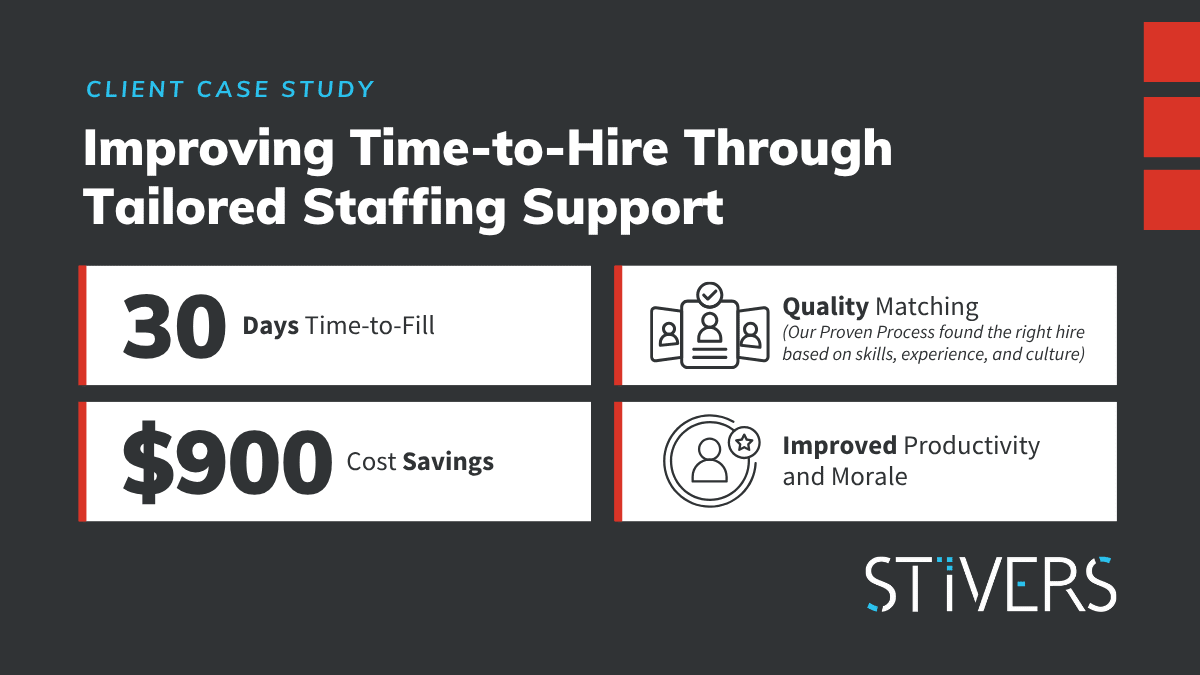
- 80% of our recruiting process happens before you see a single candidate. We screen, vet, and calibrate behind the scenes so you’re only spending time on people who are genuinely worth your consideration. Less noise, faster decisions, shorter time-to-fill.
- We move quickly because we stay close. Using a combination of technology, established relationships, and 80 years of recruiting experience, we connect you with qualified candidates faster without sacrificing the fit that makes a placement last.
In hiring, the right match matters. But so does the process that gets you there. If communication with your current staffing partner feels like a one-way street, we’d like to show you what the other kind looks like.
Ready to work with a staffing partner who communicates differently? Contact us or explore our Employer Resource Library to keep building your hiring strategy.